
ACADEMIC MATTERS
SUBJECTS OFFERED
All learners in Grade 8 and 9 will study the following compulsory learning areas:
- English (Home Language)
- Afrikaans (First Additional Language)
- Mathematics
- Natural Sciences
- Human and Social Sciences
- Life Orientation
- EMS (incorporating Accounting)
- Creative Arts
- Technology
Learners in Grade 10, 11 and 12 follow the new curriculum:
- 3 compulsory subjects – English (HL), Afrikaans (FAL) and Life Orientation
- A choice of Mathematics or Mathematical Literacy
- 3 other subjects chosen from:
– Physical Science
– Life Science
– History
– Geography
– Accounting
– Business Studies
– Engineering Graphics & Design
– Consumer Studies – Cooking
– Information Technology
– Computer Applications Technology
– Visual Art
ASSESSMENTS AND REPORTS
Assessment consists of two components, namely a portfolio of evidence of achievement gathered during the school year (SBA or School-Based Assessment), and end-of-year examinations.
Each subject has different requirements for SBA. Some have practical components, but all will include some form of testing. Learners should therefore apply themselves regularly throughout the year, rather than rely on bursts of effort just before the exams.
The final promotion mark is weighted as follows:
| GRADE | SBA | FINAL EXAM |
| 8 | 40% | 60% |
| 9 | 40% | 60% |
| 10 | 25% | 75% |
| 11 | 25% | 75% |
| 12 | 25% | 75% |
In subjects with a practical component, the weighting is as follows:
25% SBA + 25% Practical + 50% Exam
- Assessment tasks are extremely valuable and must be handed in responsibly. Should an assessment task not be submitted by the date on which it is due, penalties will be incurred.
- A testing programme which indicates the class tests that are to be written during the term is issued at the beginning of each term.
- In Term 1 and 3, there is Formal Assessment that takes place in the last two weeks of the term.
- Exams are written in the last three weeks of Terms 2 and 4.
- Parents are urged not to make early holiday arrangements that will result in learners missing any Formal Assessment or Exams.
Reports are issued after each assessment cycle and at the end of the year.
The man who doesn’t read books has no advantage over the man who can’t read them.
Mark Twain
HOMEWORK
The purpose of homework is to extend learning beyond the classroom and to consolidate work that has been taught.
The Education Department recommends the following hours of study (daily):
Grade 8 – 1½ hours
Grade 9 – 2 hours
Grade 10 – 2 hours
Grade 11 & 12 – 3 hours
- Homework should be completed on the same day on which it is issued, even if the deadline is not for the next day. This will help eliminate unnecessary stress.
- This time should be spent not only on doing specific homework set by the educators but also on individual study, consolidation of work, revision and preparation for tests.
- It is also strongly recommended that 15-20 minutes be set aside on a daily basis for reading. The High School Curriculum is heavily rooted in literacy. Every single subject has, at its core, the need for learners to understand the finer skills of reading. Learners who read regularly have improved vocabularies; their writing skills are enhanced; they are able to complete tasks and tests more easily and their understanding is sharpened.
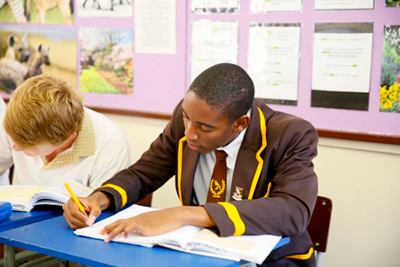
Academic success is dependent on regular and varied reading and parents are encouraged to develop a culture of reading at home.
ACADEMIC SUPPORT PROGRAMME
Rand Park offers academic support lessons in order to assist learners who may be struggling with certain subjects.
The following subjects form part of the Academic Support Programme:
- Accounting
- Afrikaans
- EMS
- English (Junior)
- Mathematics
- Maths Literacy
- Physical Science
- Life Sciences
The schedule for this programme is made available at the beginning of each term.
Learners who require assistance in any of their other subjects are encouraged to approach their subject teachers to schedule individual support lessons.
The Counselling Department also assists learners with study skills, time management, subject and career choices, as well as dealing with problems of personal adjustment.
BOOKS AND STATIONERY
At Rand Park High School, learners must provide their own stationery (paper, pens, pencils, rulers, calculators etc.) and textbooks. Occasionally, textbooks are supplied by the Department of Education in some of the core subjects and some set works are provided by the school for use by learners during the course of the year.
Some grades may be asked to pay a book deposit at the beginning of the year in order to access certain textbooks provided by the school. A portion of this deposit is refunded at the end of the year when the books are returned to the school.
Textbook and stationery lists, which provide details of all the requirements for the next Grade, are emailed to all parents toward the end of each year. These lists will include information regarding the school’s preferred stockists. The onus is on the parents to ensure that purchases are made timeously.
To ease the burden of the high cost of textbooks, the school has an arrangement with FERNDALE TEXTBOOKS (011 781 3379) – they buy back and re-sell second-hand textbooks at a cost well below list prices.
It is therefore in your interests to ensure that textbooks are carefully looked after and carried in a sturdy bag.
We recommend a back pack with multiple compartments and double shoulder straps so that the weight of the bag is evenly distributed.
It is expected that learners will begin the school year with ALL the stationery and books required to achieve success in all their subjects.
Learners have the option of using electronic devices such as e-readers or tablets on which they may store and access electronic versions of their textbooks. The onus is on the parents to access and download the e-textbooks. Please note that some textbooks are available on both Apple and Android devices, while others are only available for use on Apple devices.
There are no prescribed requirements regarding which tablet is preferable but we recommend a device that complies with the following specifications:
- 10-inch screen (colour)
- 800×480 screen resolution
- 8 hour battery life
- 8GB on-board memory
- 3G connectivity (a data package will be required to access the internet to download e-textbooks)
- Able to open pdf files
It is also advisable to invest in a good cover and screen protector.
The school will take no responsibility for damage to, or loss of electronic devices that are brought to school. Learners will need to ensure that their devices are fully charged before coming to school as they will not be able to recharge them during the school day. Any misuse of the device, i.e. using it for non-educational purposes or for purposes not specifically authorised by the teachers will constitute misconduct and will result in the device being confiscated and disciplinary action being taken.
Download the Textbook and Stationery Letter to parents.
Download the Grade 8 Stationery list for 2026.
Download the Grade 8 Textbook list for 2026.
Grade 9-11 Textbook and Stationery Lists are available here.
The d6 School Communicator also provides Stationery and Textbook lists for all grades.
MEDIA CENTRE SERVICES
The Media Centre is the ideal place to work quietly on homework and projects. It is open every break, with the exception of Tuesdays, as well as after school for two hours from Monday to Thursday.
Up to three books may be taken out at a time; black and white printing/photocopying can be done and there is Internet access for research purposes.
Media Centre Monitors are available to assist in finding resources, either for leisure or academic pursuits.